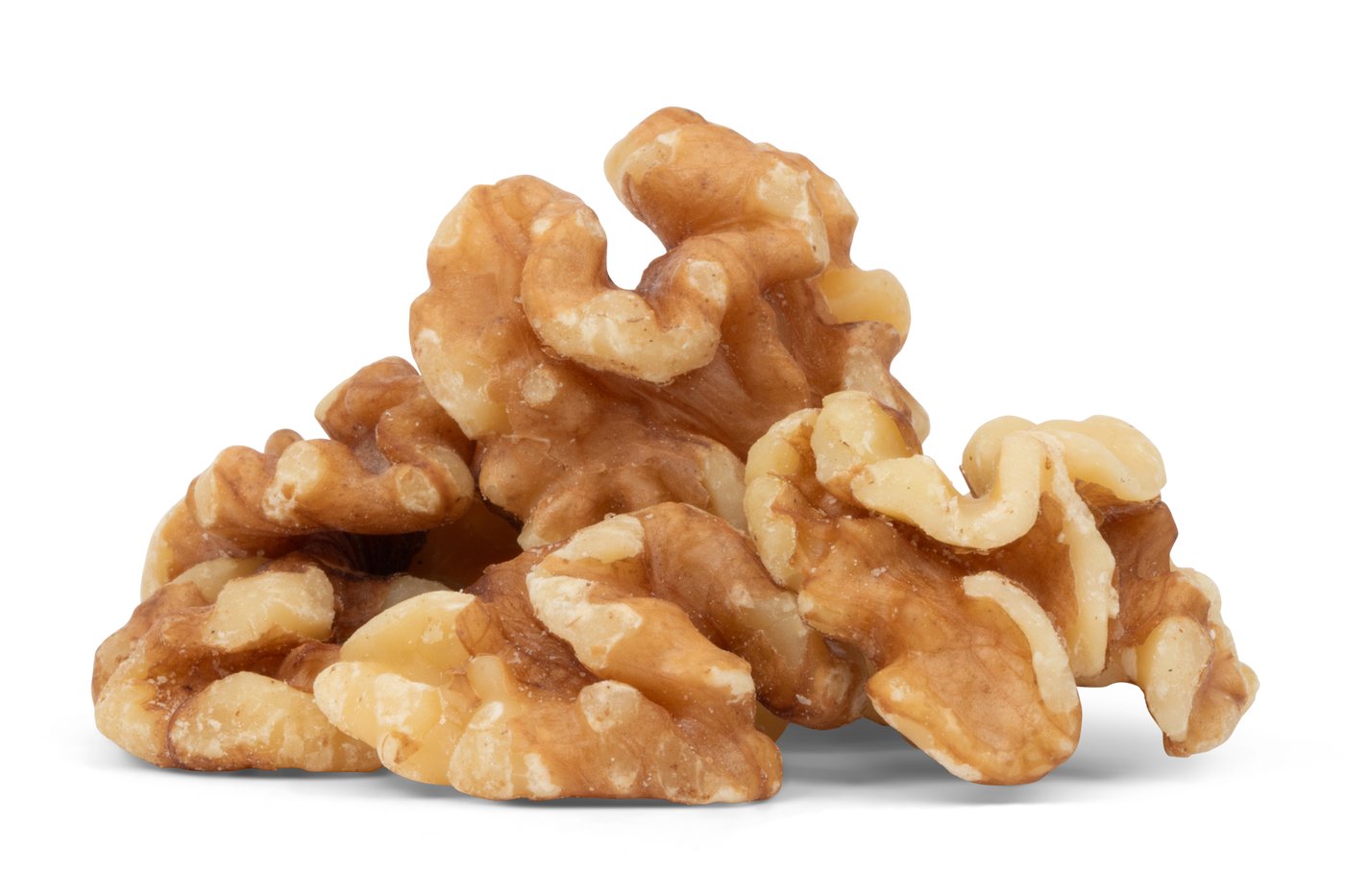

English Walnuts (Raw, No Shell)

Order now, we'll ship wednesday, jun 19
  1. $9.99/lb
  2. $9.69/lb
  3. $6.99/lb (bulk - not individually packaged)
See our bulk discounts

Certified: Gluten-Free Kosher

A very common ingredient found in many baking items. These walnut halves and pieces are mainly grown in California and Oregon.

Health Tips

1. There are few foods that are as nutritiously complete and good for the human body as walnuts. For more than a dozen years, research by highly-respected scientific and clinical experts has continued to reveal that this "Super Food" is packed with nutrients that positively affect the body on a multitude of levels. Walnuts are unique as one of the most nutrient-dense whole food sources of alpha-linolenic acid (ALA), an essential omega-3 fatty acid. Numerous studies have concluded that omega-3s help reduce the potential for heart disease, cancer, stroke, diabetes, high blood pressure, obesity and clinical depression. The bottom line is that walnuts contribute nutrients essential to a healthy lifestyle. Eating walnuts is one of the easiest things a person can do to improve their health. Best of all, they taste great and are ideally suited for inclusion in any diet, as part of meals or snacks.

2. A new study conducted in Australia shows that, for patients with type 2 diabetes, a whole foods diet including walnuts can reduce LDL "bad" cholesterol by as much as 10 percent. Findings of this new study are published in the December 2004 issue of Diabetes Care, a journal of the American Diabetes Association (ADA). Primary study investigator Linda Tapsell, Ph.D., APD, director of the National Centre of Excellence in Functional Foods, located at the University of Wollongong, Australia, says, "This is one of the first studies to look at the effect of polyunsaturated fatty acids on diabetes management. Walnuts are an easy and convenient way of getting polyunsaturated omega-3 fatty acids into the diet. And they're particularly important for people with diabetes because they are a simple snack food, which is an integral component of managing the diet in diabetes." Tapsell says that a diet including walnuts can help the body address one of the problems associated with early stage type 2 diabetes — insulin resistance — which hinders the absorption of glucose from the bloodstream into human cells.

3. An ever-growing body of research has shown that walnuts play a significant role in reducing the risk of heart disease. The heart benefits of walnuts include lowering cholesterol, reducing inflammation and improving arterial function. Results from a November 2004 study from The Pennsylvania State University (published in the Journal of Nutrition) showed that eating walnuts can significantly reduce C-reactive protein and harmful plaque adhesion molecules, two significant markers of inflammation in arteries. Penny Kris-Etherton, Ph.D., distinguished professor of nutrition at Penn State and primary investigator for the study says, "The important new finding with our research is that a diet high in walnuts beneficially affects multiple risk factors for coronary heart disease, which can have a greater impact on decreasing cardiovascular risk than just targeting single risk factors." Many people look to fish, such as salmon, for omega-3s. However, Kris-Etherton says, "The omega-3 fatty acids in walnuts were converted to the same omega-3 fatty acids found in marine sources, and had a similar effect on inflammation. Reducing inflammation can help decrease the progress of arteriosclerosis   the development and build- up of plaque in the arteries." A March 2004 clinical study from the University of Barcelona showed that substituting walnuts for monounsaturated fat in a Mediterranean diet improved, and even restored, endothelial function (the elastic property of arteries to dilate when meeting an increased demand of blood). The study also showed that walnuts reduce cell adhesion molecules associated with atherosclerosis, commonly known as hardening of the arteries. These dual effects enhance the circulatory system, aiding in the prevention of heart disease. According to the researchers, walnuts are the first whole food to show such cardiovascular benefits. The study was published in Circulation: Journal of the American Heart Association (March/April 2004). Research from The Pennsylvania State University showing that an ALA diet improves vascular function was reported at the American Heart Association's 5th Annual Conference on Arteriosclerosis, Thrombosis, and Vascular Biology in San Francisco (May 2004). Lead author Sheila G. West, Ph.D.says, "Our findings suggest that the special kind of fatty acids that are present in walnuts can improve the function of arteries and allow them to dilate better." Additionally, a University of San Francisco study published in Stroke in l995 found omega-3s reduced the incidence of stroke. California's Loma Linda University, in 1993 clinical trials, was the first to find that walnuts in a controlled diet reduced "bad" LDL cholesterol and heart disease risk significantly more than the Step 1 diet that was then recommended by the American Heart Association. Five walnut studies reviewed in 2002 by the Life Sciences Research Office (LSRO) — an independent, non-profit organization that conducts peer-reviewed scientific reviews, prepares expert documents and manages scientific meetings — confirmed these findings, which also demonstrated that the walnut diet out-performed a healthy Mediterranean diet. In addition, the Kyushu University (Japan) clinical study, also published in 2002, showed a healthy Asian-style diet to be even healthier with walnuts.

4. There have been major changes in the American diet in the past few decades as people have increased their use of processed foods, which are loaded with unhealthy doses of saturated- and trans- fats. This has led to an unhealthy balance of essential fatty acids (EFAs). Ideally, the two families of EFAs (omega-6 and omega-3) should be balanced in a ratio of no more than 4:1 for optimum health. The average American's dietary ratio can be in excess of an alarming 20:1, or more. Artemis P. Simopoulos, M.D., president of The Center for Genetics, Nutrition and Health and author of The Omega Diet says, "Walnuts are unique because they have a perfect balance of omega-6 and omega-3 polyunsaturated fatty acids, a ratio of 4:1, which has been shown to decrease the risk of sudden death in the Lyon Heart Study." Simopoulos says omega-3s reduce the bloodstream levels of LDL (bad) cholesterol and maintain or raise HDL (good) cholesterol.

The presence of omega-3s reduces blood pressure, arterial inflammation and the stickiness of platelets, making them less likely to cling together and form plaque, which can build-up, rupture and plug arteries. EFAs, particularly omega-3s, may also play a role in reducing arrhythmia (irregular heart beat pattern) and cardiac arrest. Take, for example, the U.S. Physicians' Health Study (Harvard), published in June 2002. The study, which followed 21,454 men for an average of 17 years, illustrated that dietary nut intake was associated with a significantly reduced risk of sudden cardiac death. The Lyon Heart Study published in Lancet in l994 showed healthy EFAs in the blood reduced clotting and inflammation, decreasing risk for clogging of the arteries and sudden heart attack by 70 percent.

5. Reported in June 2004, a USDA study of food antioxidants noted the high antioxidant concentration in walnuts. Antioxidants help the body ward off life-threatening maladies such as cancer, heart disease and diabetes, as well as debilitating ailments such as arthritis, osteoporosis and Alzheimer's disease. While there are several different methods used to measure antioxidant levels, such as the oxygen radical absorbance capacity (ORAC) and the ferric-reducing ability of plasma (FRAP) methods, walnuts rank highly under either method.

6. The latest study from Australia once again affirmed that the health benefits from eating walnuts do not come at the expense of weight gain. Researchers have noted in many walnuts studies that subjects did not gain weight when walnuts were substituted for other fat in the diet. People reported feeling more satisfied; many said walnuts made it easier to stick to a diet. This response was also noted by McManus et al in their study published in October 2001 by the International Journal of Obesity, which concluded that people following a moderate fat weight loss diet, including peanuts and tree nuts, such as walnuts, were able to improve weight loss and keep weight off for a longer period than people following the traditionally recommended low-fat diet.

7. In a landmark decision in March 2004, the U.S. Food and Drug Administration (FDA) delivered the strongest governmental endorsement of walnuts to date when it affirmed: "Supportive but not conclusive research shows that eating 1.5 ounces per day of walnuts, as part of a low saturated fat and low cholesterol diet and not resulting in increased caloric intake, may reduce the risk of coronary heart disease. See nutrition information for fat content." This FDA decision came in response to a petition filed by the California Walnut Commission, which highlighted a body of international scientific research substantiating the benefits of eating walnuts as part of a heart- healthy diet. The body of evidence suggests that the nutritional composition of walnuts contributes to these heart health benefits.

8. In historical terms, walnut science is new and cutting-edge. Yet their health lore is ancient. It's interesting to glance back and remember that during Medieval times, walnuts were considered a medicine. A potion containing walnut leaves was used to treat muscular aches and pains and walnuts were believed to soothe the digestive system. Later, in the 16th and 17th centuries, herbal treatments became official medical practice under the "Doctrine of Signatures," and various plants were prescribed due to their resemblance to a particular body part. Hence, the walnut, with its visual likeness to the human brain, was used to treat head ailments, boost intellect and calm emotions. Even today, in Asian cultures, the walnut is considered a brain food; college students there munch on walnuts by the handful before exams, hoping to boost their scores. Depending on which way a walnut is cracked open, it has a striking resemblance either to the brain or the heart. Crack a walnut and see the hearts for yourself. You won't get a "perfect" heart every time, but you'll get the message: walnuts are heart- healthy.

Customer Reviews

Leave online feedback and share your thoughts with other customers!

“We just opened the gift basket of nuts and extra gift from you guys.Thank you for that.All the nuts are unbelievably fresh and soooo good.The dates are fresher than any I can get in town!!! Have a blessed Christmas.We will definitely be ordering again.”

Beverly J Eschmann, Topeka, Ks December 21, 2010

“Hey Thanks for the speedy delivery! My daughter and I made 5 lbs of candied spice walnuts today and they are delicious! Happy Holidays to all of you! Janine”

Janine, west chester, pa December 18, 2010

“thanks i received my bonbons today and are so good and fresh, as well as the unshelled walnuts, can't wait until every one can taste them and walnuts are over the web saying how good they are for you, thanks do much.”

joyce, florence, ky December 10, 2010

“Arrived very quickly and tasted delicious! They were fresh and the packaging was also great. I was worried about it being smashed up in the mail. Will be buying from here again. Thanks!”

Julianne, Roanoke, Virginia October 28, 2010

“OMG! The dried strawberries are AWESOME! I got the about an hour ago and have already ate 1/2 the bag. And the walnuts are soooo fresh.....I love them. You guys are awesome!!!”

Ginger, Weatherford, Texas May 19, 2010

“Great product. Was advised by my doctor that this was "the source" for nuts and nuts are a central part of my diet. The healthiest nuts are walnuts and pecans and it's really hard to find consistently excellent ones; bags without "bad" nuts. These nuts are GREAT and no imperfect ones. Keep up the good work.”

bill, houston, tx April 27, 2010

“My first order arrived in 2 days and two of the three items were gone in 4 days. The dried cranberries were tangy and plump, not gummy and chewy. The blueberries were a revelation--never ate dried blues before. The walnuts were beautiful--whole halves, not pieces, and fresh and crunchy. And I was tickled with the familial nuttiness and I can identify with it all too well!!! Thanks--and I'll be back.”

Anne March 2, 2010

“Excellent walnuts. variety of sizes from full halves to 1/2 size pieces. Really good for snacking on. Will be ordering more in the future.”

Chris, Carrollton, Texas November 7, 2009

“Thank you for the wonderful NUTS! Very fresh,and so quick! I bake a lot and I will use your products in all of my goodies.”

Chris, yulee, florida September 8, 2009

“Thanks for your great service! This is my second purchase and I will be returning. The English walnuts are wonderful, I love the freshness and there is not a bad nut in the bunch. The sample size option is a great idea! ”

MICHELLE, clarksville, tn June 18, 2009

“Placed my first order yesterday and it arrived today. Amazing! How do you nuts manage that? Nicely (and amusingly) packaged. The walnuts are the best I've had in a very long time. Thanks very much for the sample pack of Organic Quinoa.


Valerie, East Greenville, PA June 15, 2013

Nutrition Facts

Serving Size 30g (~1.1 oz.)
(Approx. 15.2 Servings/Pound)

Amount Per Serving
Calories 210
Calories From Fat 180
%DV
Total Fat 20g 31%
Saturated Fat 1.5g 8%
Cholesterol 0mg 0%
Sodium 0mg 0%
Total Carbohydrate 3g 1%
Dietary Fiber 3g 14%
Sugars 0g
Protein 5g
Vitamin A 0% Calcium 2%
Vitamin C 0% Iron 6%

Ingredients

Walnuts

Packaged in the same facility as peanuts, tree nuts, soy, and milk products.

Storage

Store under refrigeration for up to 6 months.

ID: 3019